
Quick answer: The 7 website features that consistently turn visitors into paying customers in 2026 are: (1) a dynamic homepage, (2) a clear page hierarchy, (3) a compelling "About" page, (4) a results-driven portfolio with case studies, (5) transparent pricing, (6) intuitive navigation tools, and (7) strategic calls-to-action on every page. Combined with solid SEO and AI search optimization, these features turn your website into a 24/7 lead generation engine.
Why your website is your most important sales tool in 2026
Let's be honest. Why do businesses invest in websites? It is not just for the fun of it. A website is a strategic business investment, and for a small or medium-sized company, it can take a real bite out of the budget. So it needs to deliver a return that justifies the time, energy, and money spent on it. A quickly assembled page with two paragraphs and a stock photo of a dog will not cut it.
Everyone keeps talking about search engine optimisation (SEO), and rightly so. Keyword-rich content still matters in 2026. But the rules of the game have changed. With Google AI Overviews, ChatGPT Search, and Perplexity now handling an estimated 25% of global queries, your website also has to satisfy AI search engines and the most important visitor of all: your potential customer. Search engines and AI assistants give you reach and visibility; converting that reach into revenue is up to your website.
The good news? Proven techniques exist to generate qualified leads through your website. That is where User Experience (UX) design comes in. Rather than randomly scattering information across pages, every element of your navigation should be planned around your target customer. UX design is the discipline of creating a website that delivers a meaningful, enjoyable, and memorable experience.
At 4BIS, we have built dozens of websites for clients across industries over the years, and we have learned what works (and what does not). Below are the 7 website features that consistently make the difference between an "okay" website and one that actually generates business.
1. A Dynamic Homepage That Hooks Visitors in 3 Seconds
Your homepage is usually the first page visitors see, and often the only one they read in full. You have roughly three seconds to make a strong first impression before they decide whether to stay or bounce.
Showcase your main value proposition, your business strengths, and the key information potential clients are looking for, all above the fold. Keep the UX golden rules in mind:
- Meaningful: be relatable, informative, and relevant to the visitor's problem.
- Enjoyable: be straightforward, readable, and well-structured.
- Memorable: be visually distinctive, on-brand, and a little bit fun.
Treat your homepage as the living heart of your website. Add dynamic content blocks such as your latest blog articles, upcoming events, or recent client wins to keep things fresh and give visitors a reason to return. Include clear internal links to your most important subpages.
2. A Logical Page Hierarchy That Tells Your Story
A strong brand tells a story, and a story only works if the chapters are in the right order. That is why your website needs a clear hierarchy and a navigation menu that guides visitors from awareness to decision.
Rather than dumping all your products or services onto a single page, organise them into pages and subpages. Each page should be categorised around a specific problem your customer is trying to solve, with that problem reflected in the page title and headings. This is also how AI search engines like Google AI Overviews understand what your content is about, so a clear structure helps you get cited in AI-generated answers.
Use internal links to encourage visitors to explore deeper. The longer they stay engaged, the more likely they are to convert. Just do not force them to click endlessly to find basic information.
3. An "About" Page That Builds Trust and E-E-A-T
Every good story has a chapter about the hero. In 2026, your "About" page is more important than ever, not just for human visitors but for search engines. Google's E-E-A-T framework (Experience, Expertise, Authoritativeness, Trustworthiness) rewards websites that clearly show who is behind the content and why they are qualified.
Write about your company's history, values, and culture. Introduce your team with real photos (not stock images), names, and credentials. Mention years of experience, certifications, awards, and the types of clients you serve.
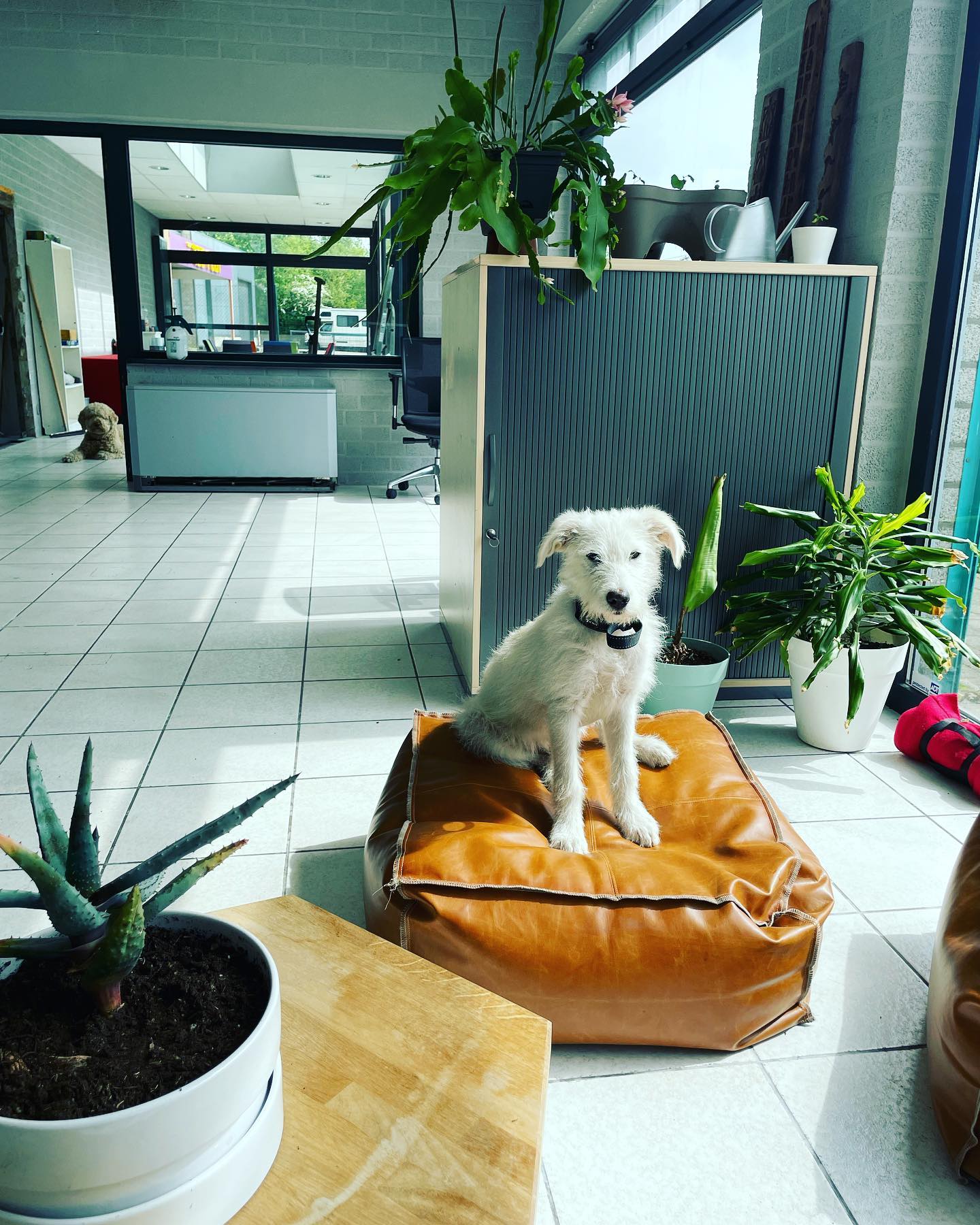
Having a brand mascot can also help your business stand out in a crowded market. Just ask Bobby the dog, the 4BIS mascot, who loves showing us off!
4. A Portfolio With Real Case Studies and Measurable Results
Show, do not tell. You know you are great at what you do, but your future clients have no way of knowing yet. They need proof.
Listing past clients is good. Adding testimonials is better. The gold standard, however, is a portfolio with detailed case studies that include:
- The client's original problem or goal.
- The solution you delivered.
- Concrete results with numbers (e.g., "increased leads by 47% in 3 months").
- A short quote from the client when possible.
Concrete figures are also what AI search engines pull into their summaries when a user asks "who is good at X in [region]." Specific data makes you quotable.
5. A Pricing Table (Or at Least a Price Range)
If you have ever shopped online, you know the question that pops up first: "Yes, looks great, but how much?"
Giving at least an indication of your pricing is essential, because most people will not contact you just to ask. A 2026 user expects transparency, and AI assistants often pre-filter recommendations based on budget signals on your site. Without visible pricing, you are invisible to that filter.
If you genuinely cannot publish exact prices (custom projects, variable scope), publish a price range, a "starting from" figure, or sample package tiers. Anything is better than nothing.
6. A Sitemap and Smart Navigation Aids
A great website conveys information quickly, clearly, and effortlessly. To keep users (and search engine crawlers) happy, your site must be easy to navigate at all times. Essential navigation features include:
- A sitemap (both an HTML one for users and an XML one for search engines).
- "Back-to-top" buttons, especially valuable on mobile, where roughly 65% of web traffic now comes from.
- A working search bar, with autocomplete if possible.
- Breadcrumbs, the hierarchical links that show visitors exactly where they are on your site (e.g., Home > Services > Web Development).
- A sticky main menu that stays visible while scrolling.
7. Strategic Calls-to-Action on Every Page
Last, but arguably most important. Some marketers would argue calls-to-action (CTAs) are the number one feature to get right. The good news: they are also the easiest to implement.
Your entire website exists to win new business. Once you have convinced a visitor that you understand their needs, give them a clear, frictionless way to act. Every page should include at least one prominent CTA:
- "Request a free quote"
- "Book a 15-minute discovery call"
- "Download our guide"
- "Subscribe to our newsletter"
- "Contact us"
Make your CTAs visually distinct (a contrasting colour helps), action-oriented, and specific. "Get my free SEO audit" beats a vague "Submit" button every single time.
What is new for websites in 2026? Bonus: AI search optimization
Beyond the classic 7 features, there is one area you cannot ignore in 2026: optimizing for AI search engines and answer engines. Google's AI Overviews now appear on the majority of informational queries, and platforms like ChatGPT Search, Perplexity, and Bing Copilot are pulling traffic away from traditional "10 blue links" results.
To stay visible, make sure your website also includes:
- Structured data (Schema.org markup) for FAQs, articles, reviews, products, and your local business profile.
- Clear, scannable answers placed near the top of each page so AI engines can quote you directly.
- Author bios and credentials on every article (E-E-A-T signals).
- Fast Core Web Vitals scores: load time under 2.5 seconds, minimal layout shift.
- Consistent NAP data (Name, Address, Phone) across your site, Google Business Profile, and major directories.
- An llms.txt file in the root of your site to guide how AI crawlers use your content.
Frequently Asked Questions
What are the most important features of a high-converting website in 2026?
The most important features are a dynamic homepage with a clear value proposition, a logical page hierarchy, a trust-building "About" page, a portfolio with measurable case studies, transparent pricing, intuitive navigation (sitemap, breadcrumbs, search), and prominent calls-to-action on every page. In 2026, these should be backed by structured data and AI-search-friendly formatting.
How long should it take to build a professional small business website?
A professional small business website typically takes between 4 and 12 weeks to build, depending on scope. A simple brochure site can be done in 4 to 6 weeks; a custom site with e-commerce, a blog, or integrations usually requires 8 to 12 weeks. Rushing this process is one of the most common reasons websites underperform.
How much does a good small business website cost in 2026?
In 2026, a professional custom website for a small business typically costs between €3,000 and €15,000, depending on features, design complexity, and content needs. E-commerce sites and sites with custom integrations generally start higher. Beware of providers offering "complete websites" for a few hundred euros, since these are rarely optimized for SEO, UX, or AI search.
Do I really need a blog on my website?
Yes, for most businesses a blog is one of the highest-ROI features of a website. Regular, helpful blog content boosts SEO rankings, increases the number of pages eligible to appear in Google AI Overviews, and gives you something to share on social media and in newsletters. Even one quality article per month outperforms no blog at all.
What is the difference between SEO and AI search optimization?
Traditional SEO optimizes your site to rank in classic search results (the "10 blue links"). AI search optimization, sometimes called AEO (Answer Engine Optimization) or GEO (Generative Engine Optimization), ensures your content is structured so that AI engines like Google AI Overviews, ChatGPT, and Perplexity can find, trust, and cite it. According to Google's own 2026 guidance, the two largely overlap: doing SEO well is doing AI search well, with extra emphasis on clear answers, structured data, and unique expert content.
How often should I redesign my website?
As a rule of thumb, a full redesign every 3 to 4 years is healthy, with smaller content and design refreshes every 6 to 12 months. If your bounce rate is climbing, your design looks dated compared to competitors, or your site is not mobile-friendly, it is time for a refresh sooner.
Is mobile-first design still important in 2026?
Absolutely. Over 65% of web traffic now comes from mobile devices, and Google has used mobile-first indexing for years. If your website does not look and perform brilliantly on a smartphone, you are losing customers and rankings simultaneously.
Can I build a website that converts without hiring a professional?
You can, using platforms like Squarespace, Wix, or WordPress, and a good template will get you a basic site. However, conversion-focused design, UX research, SEO setup, and AI search optimization usually require professional input. The investment in a professional typically pays for itself within 6 to 12 months in additional leads and sales.
Ready to turn your website into a lead generation engine?
These 7 features, combined with strong SEO, AI search optimization, and a clear offer, will make your website investment pay off for years to come. You will earn back every euro you put in and more.
If reading this has you itching to improve your current website or build a sparkling new high-performing website or webshop, we would love to help. Explore our web development services or get in touch with the 4BIS team to start the conversation.
We are here to answer your questions and to accompany you on your web adventure.
Greetings,
The 4BIS team