
Since November 2025, Symfony 8 and PHP 8.5 have been available. The latest version of Symfony is 8.0.7, released on March 6, 2026. This version is not a Long Term Support (LTS) release; the next LTS version will be Symfony 8.4, which is still under development. The minimum required PHP version for Symfony 8 is 8.4, representing a significant leap in speed and security for Symfony applications.
That's all well and good, but is it worth using the latest PHP versions and migrating all dependencies? Absolutely! Also, read our article on "Technical Debt".
PHP 8.5.4 and Symfony 8.0.7: Benchmarks and Performance
Recent research shows that performance improvements between PHP 8.4 and 8.5.4 for Symfony 8.0.7 are limited but measurable. Benchmarks indicate that Symfony 8.0.7 on PHP 8.5.4 is about 3–5% faster than on PHP 8.4, especially for complex tasks such as database operations and API processing. This is particularly relevant for SaaS platforms and applications with high computational and processing demands.
| Configuration | Performance Gain (Symfony) | Performance Gain (PHP) | Key Benefits |
|---|---|---|---|
| Symfony 7.4 to 8.0.7 (same PHP) | < 2% | – | No deprecated features, better compatibility with PHP 8.4+ |
| PHP 8.3 to 8.4 (Symfony 7.4/8.0.7) | 7–70% | 5–10% | Faster execution, better JIT support |
| PHP 8.4 to 8.5.4 (Symfony 8.0.7) | 3–5% | 3–5% | Improved URI parsing, pipe operator, better object cloning |
Key Updates in Symfony 8.0.7
- Bug fixes for PSR-0/PSR-4 fallback directories and improved compatibility with PHP 8.5
- Optimizations in the Dependency Injection component and HTTP Foundation
- Improved support for modern PHP features such as Property Hooks and Asymmetric Visibility, enhancing application security and flexibility
Key Updates in PHP 8.5.4
- New URI extension for better URL parsing and validation, based on RFC 3986 and WHATWG standards
- Introduction of the pipe operator (|>) for simpler function chaining
- Support for modifying properties during object cloning, especially useful for readonly classes
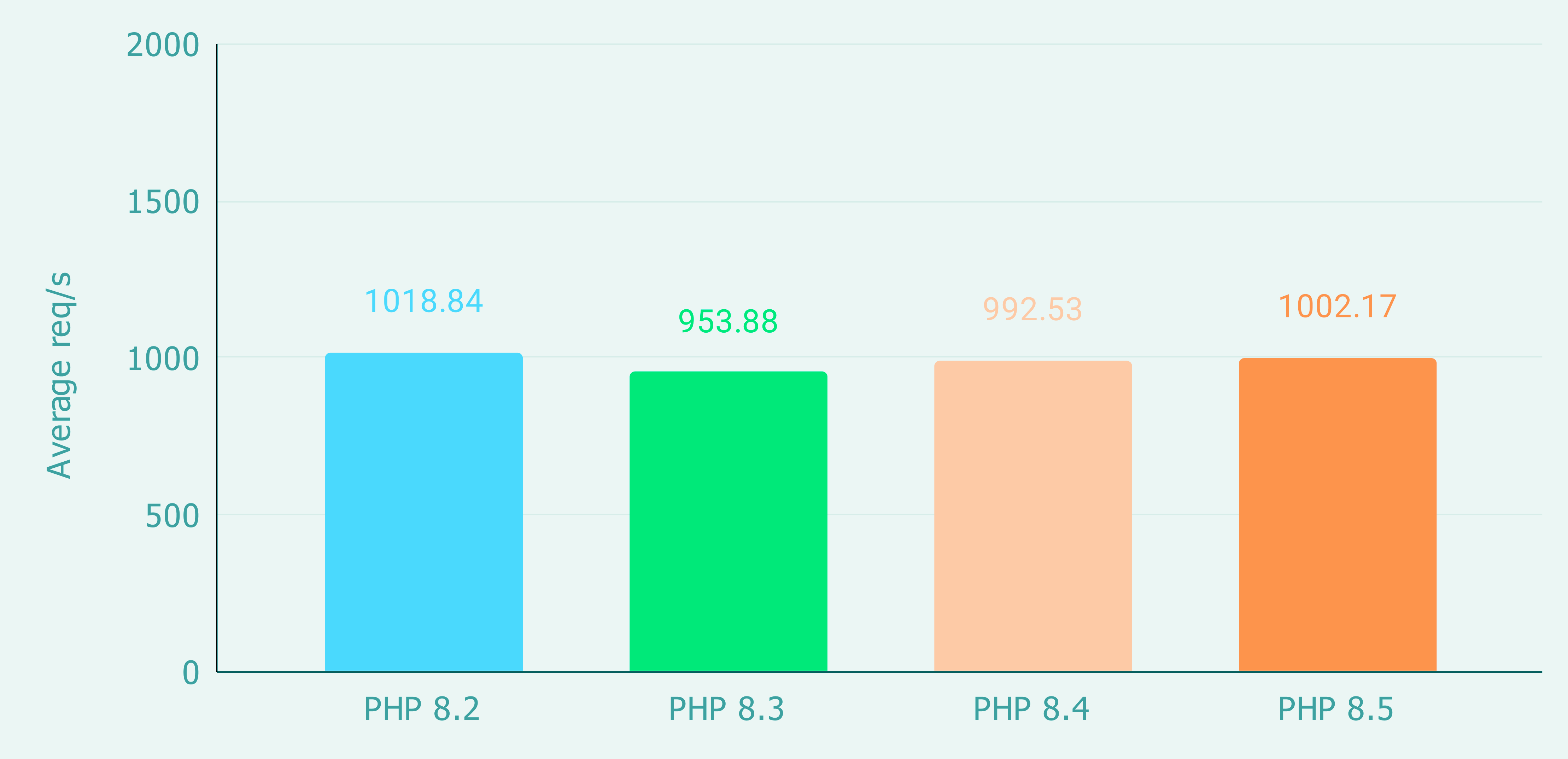 Benchmark Symfony 7.4 performance with different versions of PHP
Our Journey
We examined the configuration of a project approximately one year old, with high demands on computational power, API processing, and a customer portal with document and task management. The platform is specifically designed for automating business processes and providing insights into efficiency gains for organizations.
This application is part of the CicloudPro suite (cicloudpro.com), our platform for digital process automation, document management, and scalable SaaS solutions for modern businesses (CaseManager CRM).
Our original setup ran on PHP 8.4.1 and Symfony 7.4. The decision to migrate to PHP 8.5.4 (March 2026) was not straightforward, as the improvements initially seemed incremental. However, the ongoing development of a SaaS platform requires more than just minor adjustments in business logic—consider performance, scalability, maintainability, and future-proofing.
Challenges and Solutions
The upgrade did not come without challenges. PHP 8.5.4 is not yet natively supported on all Ubuntu servers, requiring additional configuration. Furthermore, several dependencies had to be adjusted to ensure compatibility with Symfony 8.0.7.
These efforts have paid off in the form of better performance and a future-proof codebase.
Conclusion
The upgrade to PHP 8.5.4 and Symfony 8.0.7 has made our SaaS application faster, more secure, and scalable. For businesses looking to optimize their process automation, this combination provides a solid foundation for further growth and innovation.
Want to know more about the benefits of process automation or our experiences with this upgrade? Feel free to contact us.
Sources
Frequently Asked Questions (FAQ)
Not always. For stable applications on PHP 8.4, there is no immediate need, but for future-proofing and slight performance gains, an upgrade can be worthwhile.
On average, the gain is around 3–5%, but for specific workloads and JIT usage, this can be significantly higher.
Yes, especially compatibility with libraries and server support can pose challenges. A good testing environment is essential.
For SaaS platforms, API-intensive applications, and systems with high scalability requirements, upgrading is often a strategic choice.